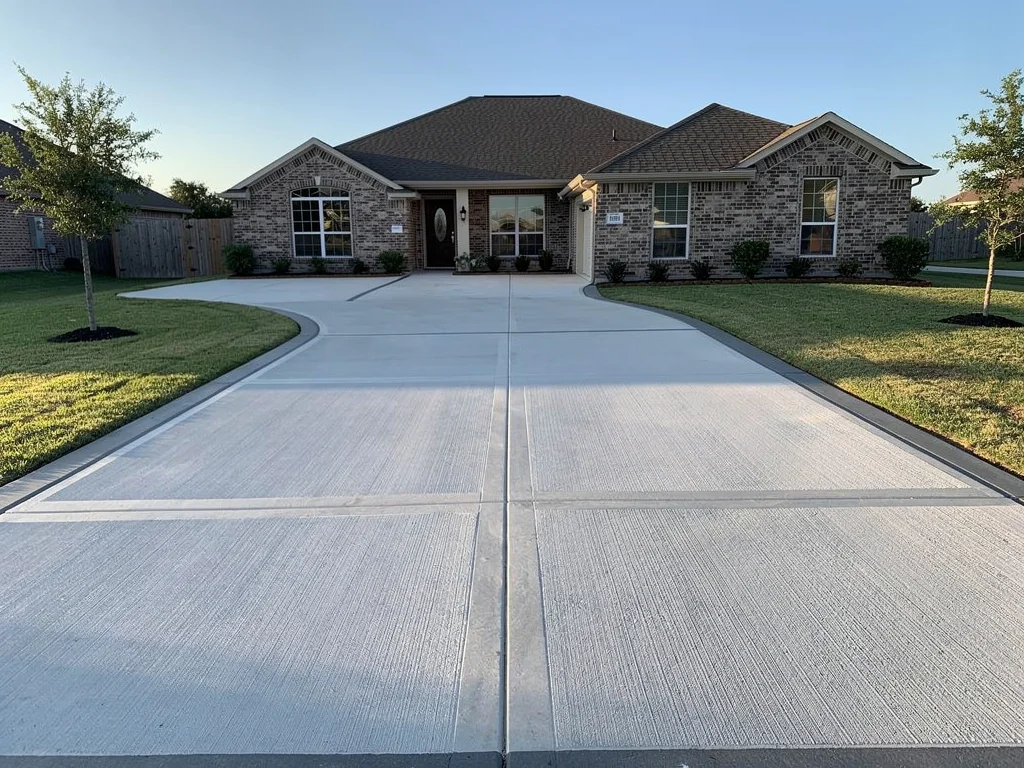
If you have lived in Cypress, Tomball, or Katy for more than one summer, you have seen what August does to a neglected driveway: hairline cracks appear, the surface goes chalky, and the color you paid for fades to a flat gray. None of that is inevitable. Most summer concrete damage is preventable with a handful of habits and one or two scheduled services per year.
This guide covers what we tell our own customers in Cypress concrete driveway installations and concrete repair calls. Use it as a checklist through Labor Day.
What Texas Heat Actually Does to Concrete
Concrete is strong in compression but vulnerable to moisture and movement. Three things happen to it during a Cypress summer:
- Rapid moisture loss during curing — if the slab was poured in summer and not properly cured, the surface dries out before the interior hydrates, leaving a weak top layer.
- Thermal expansion and contraction — a 40° swing between an air-conditioned garage and a 100° driveway puts real stress on control joints and edges.
- UV degradation of the sealer — the protective film that keeps water and oil out breaks down fastest in direct Texas sun, usually within 12–18 months.
That is why our driveway installation specs include a 28-day wet cure, saw-cut control joints every 10 feet, and a penetrating silane/siloxane sealer applied at the right time. But a slab is only as good as its upkeep.
The Summer Checklist: 6 Things to Do This Month
1. Reseal If It Beads Poorly or Not at All
The water-bead test is the easiest diagnostic you have. Splash water on the driveway:
- Beads up tight and rolls off: sealer is still working. Recheck in fall.
- Spreads out, darkens the surface: sealer is gone or nearly gone — this is the most common state for a 2–3 year old driveway.
- Soaks in immediately: the surface is unprotected. Reseal before the next storm.
For Cypress homes, plan on resealing every 2–3 years. A penetrating sealer is far better than a film-forming one in our heat — it does not turn yellow, blister, or peel. If your current sealer is flaking, we can grind it off and start fresh. See our concrete maintenance tips for the full resealing walkthrough.
2. Wash Oil and Fertilizer Spills Within 24 Hours
Summer is feeding-and-driving season. A dropped transmission-fluid spot or a fertilizer drip on a hot driveway becomes a permanent stain within a day. Degrease, rinse, repeat. For rust from sprinkler water (very common with Cypress's hard well water), use a concrete-specific rust remover — not CLR, which can etch.
3. Re-cut Any Closed Control Joints
Control joints are there so cracks happen in a straight line where you cannot see them. When joint sealant hardens and pops out — which it does every summer in our climate — sand and water get in and start spalling the joint edges. Pull out the old material and backfill with a self-leveling polyurethane sealant. It is a 30-minute job per joint and saves a $600+ repair later.
4. Check Drainage After Every Big Storm
Houston-area thunderstorms drop 2 inches in an hour. Standing water on a slab is the #1 cause of surface spalling and freeze-damage-like pitting in winter. Walk the driveway and sidewalks after a storm:
- Puddles lasting more than a few hours — your slope is off, or the slab has settled.
- Water running back toward the house or garage — regrading or a small curb may fix it.
- Gutters dumping directly onto the slab — add downspout extenders.
5. Move Heavy Objects, Don't Drag
Dollies, boat trailers, and dumpsters dragged across a sealed driveway will leave track marks. Lift, set down, lift again. For boat parking, lay plywood under the tongue jack and trailer wheels.
6. Trim Back Vegetation 6 Inches From the Slab
Roots under a driveway cause heaving. Vines and ivy trap moisture against the edge and stain it. A clean 6-inch border also makes it easy to spot ant hills and rodent burrows — another common cause of edge crumbling in Cypress.
New Concrete? Don't Pour in July or August If You Can Avoid It
If you are planning a new driveway, patio, or foundation, the worst window is mid-June through mid-September. Not because the concrete won't perform — we pour all year — but because:
- Slabs cure much faster in 95°+ heat, which means a smaller window for finishing.
- Wind and sun dry the surface before it can be properly sealed.
- Afternoon thunderstorms can damage fresh concrete if the timing is unlucky.
Spring and fall pours give the most consistent results. If you must pour in summer, ask about hot-weather mix designs (retarders, chilled water, and synthetic fibers) and insist on a wet cure, not just a spray cure.
What We See Most Often in July Repair Calls
After 15+ years of concrete repair work in Cypress and the surrounding area, the same five issues account for about 80% of our summer service calls:
- Surface spalling from a failed sealer (preventable with #1 above).
- Scaling at the edges from sprinkler overspray and salt-laden water.
- Hairline cracks from thermal movement where joints were skipped or mis-cut.
- Pop-outs from reactive aggregate (rare in our area, but we see it after particularly wet springs).
- Discoloration / fading of integral color or stains from UV and irrigation.
Three of those are caught with the checklist above. The other two usually need a professional eye — if you are not sure what you are looking at, a quick photo and phone call is free.
When to Call Us Instead of DIY
A weekend of maintenance handles 90% of summer concrete care. But bring in a pro if you see:
- Cracks wider than 1/4 inch, or cracks that are still growing month over month.
- Sunken or heaved sections, especially near a garage floor or foundation.
- Extensive surface flaking that exposes aggregate (a sign the sealer failed long ago and the surface has scaled).
- Recurring water pooling despite cleaning the joints.
If you are in Tomball, Magnolia, Katy, Jersey Village, Klein, or Bridgeland, we can usually get out for a free on-site estimate within a few days. Most summer repairs we finish in a single day so the slab is back in service before the next storm.
The Bottom Line
A well-built concrete slab in Cypress is good for 25–30 years. A neglected one shows its age in five. The difference is two habits — keep the sealer fresh and keep the water moving — plus an annual walk-through with the checklist above. Spend an hour on it this weekend and your driveway will still look new when your neighbor's starts flaking next July.
For more year-round care, see our 5 Essential Concrete Maintenance Tips for Cypress Homeowners post, or if you are still in the planning stage, our guide to choosing the right concrete for your driveway.
Need a Summer Concrete Inspection?
Cypress Tx Concrete Co offers free on-site inspections in Cypress, Tomball, Magnolia, Katy, and the surrounding area. We'll tell you what's urgent, what can wait, and give you a written quote for any repair work.
Schedule Free Inspection